A Forex View From Afar

A Trader's Look At A Trader's Life

Forex Analysis

ECB Press Conference Bullet Points

Written by A Forex View From Afar on Thursday, May 08, 2008

Looking for an ECB rate cut?
Back to www.thelfb.com

• Inflation rates have risen significantly since the autumn
• inflation rates are expected to remain high for a rather protracted period of time, before gradually declining again
• upside risks to price stability prevail over the medium term
• economic fundamentals of the Euro-zone area are sound
• macroeconomic data continue to point to moderate but ongoing real GDP growth
• uncertainty resulting from the turmoil in financial markets remains unusually high and tensions still persist
• we emphasize that maintaining price stability in the medium term is our primary objective
• anchoring of medium to longer-term inflation expectations is of the highest priority
• current monetary policy stance will contribute to achieving our objective
• industrial production showed resilience
• economic sentiment generally continued to soften
• Euro-zone area economy has sound fundamentals and does not suffer from major imbalances
• domestic and foreign demand are expected to support ongoing real GDP growth
• growth in the world economy is expected to remain resilient, benefiting from strong growth in emerging economies
• strong growth in emerging economies should support euro area external demand
• employment and labor force participation have increased significantly and unemployment rates have fallen to levels not seen for 25 years
• The uncertainty surrounding the outlook for economic growth remains high
• Risk relate to the potential for the financial market turbulence to have a more negative impact on the real economy than previously anticipated.
• downside risks stem from the dampening impact on consumption and investment of further unanticipated increases in energy and food prices
• inflation from sharp increases in energy and food prices
• HICP inflation rate is likely to remain significantly above 2% in the coming months, moderating only gradually over the course of 2008
• protracted period of high annual rates of inflation
• risks to the outlook for inflation over the medium term remain clearly on the upside
• possibility of further rises in energy and food prices
• risk that price and wage-setting behavior could add to inflationary pressures
• Second-round effects stemming from the impact of higher energy and food prices on price and wage-setting behaviour must be avoided.
• monetary analysis confirms upside risks to price stability at medium to longer-term horizons
• M3 growth remained very vigorous at 10.3%
• M3 growth overstates the underlying pace of monetary expansion
• the underlying rate of money and credit growth remains strong
• The growth of household borrowing has moderated over recent months, reflecting the impact of higher short-term interest rates and cooling housing markets in several parts of the euro area
• For the time being, there is little evidence that the financial market turbulence seen since early August 2007 has strongly influenced the development of broad money and loans.
• macroeconomic data continue to point to moderate but ongoing real GDP growth
• uncertainty resulting from the turmoil in financial markets remains high
• strongly committed to preventing second-round effects and the materialization of upside risks to price stability over the medium term

Overall, Mr. Trichet had reiterated what the markets already knew, inflation pressures are strong, due to energy and food prices, moderate GDP growth put still (way) above the recessionary level, still a high level of uncertainty surrounding financial market, and strong demand from emerging countries.

What was new from the early statements was the fact that internal demand may be dampening.

In principal the inflation remarks are stronger, ruling out the possibility of a rate cut on the short to medium term, while some decrease in the economic sentiment is expected due to the high level of uncertainty

Looking for an ECB rate cut?

Written by A Forex View From Afar on Wednesday, May 07, 2008

Back to www.thelfb.com

According to WSJ, all 50 analysts asked about tomorrow’s ECB Interest Decision said they are expecting no movement. No surprise here, but afterwards, half of the analyst said they are looking for a rate cut from ECB by the end of Q3, and more then a half said the ECB will cut by the end of 2008.


A Dow Jones Newswires survey of 50 financial institutions found respondents unanimous in anticipating unchanged rates Thursday. Just under half, or 22 of those canvassed, expect the ECB to cut rates by the end of the third quarter, while 34 expect a cut by Christmas.


The thing that does not really add up as easily as it could is the economic logic. If everyone expects US growth to pick up during Q3, why would the Euro-Zone growth not pick in Q3? Would it not just be inline with the global expansion that comes from the US markets coming out of contraction? The analysts had the Euro-Zone cutting rates by the start of the summer, when asked back in December. We are very close to summer, and there is not even a rumor about cutting from officials.

The Analyst thoughts seem to be;

-the US slowdown must drag Europe into a recession, which by the way it has not, and when the US economy starts growing again the Analysts have the Euro-Zone shrinking.

-the analysts are saying that the ECB will change its inflation-fighting view for just one quarter. The analyst logic is the European-slowdown (they are foreseeing) will bring down inflation.

-the same things were said about the US slowdown as well; the Analysts said that it will bring down commodity prices and inflation due to lack of demand from the US. They were wrong, Oil just hit a record at $122 a barrel, food commodities are way up, and inflation is still high in the US.


Economists are wagering that the economic slowdown will do what’s needed to bring down inflation, giving the ECB a way to lower the policy rate without compromising its primary mandate of price stability. But they may be expecting too much, too soon.


It would be a strange call from the ECB to modify its stance so quickly, almost overnight, to one of a single mandate of price stability, to one of growth concerns.


Source:
WSJ: Economists Look for ECB Signal on Rates

Complaining about oil price…

Written by A Forex View From Afar on Tuesday, May 06, 2008

Back to www.thelfb.com

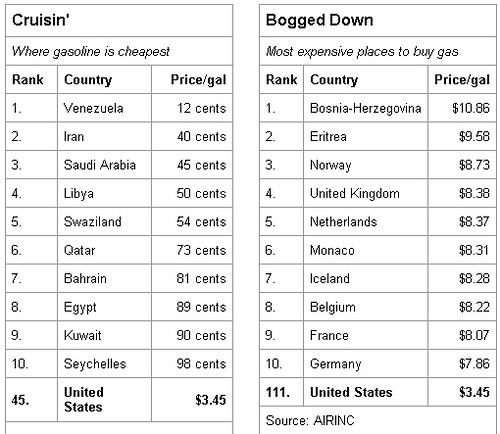
Most US Consumers complain about the higher gas prices that they have to pay, with every fill they do. Gas prices at stations have reached $3.50 per gallon, in some areas.

Gas Prices

Analysts have shown how the different Gas taxation formulas have formed different social patterns. In the US, consumers use the savings from the cheap gas to buy bigger houses, or to move further away from the downtown areas, whilst in Europe the tax money is used to modernize the transport industry, invest in education or reforming health-care (health-care that is now considered by many to be Achilles’ Heel for the US economy).

In Europe the cost per gallon is reaching $10. Furthermore, going to Economics 101, the Gas prices are only as high as they are because someone is willing to pay the price, and cutting taxes (as some political parties suggest) will only fix things in the short them.

Source:
Yahoo: Why Gas in the U.S. Is So Cheap

World Purchasing Manager Index

Written by A Forex View From Afar on Tuesday, May 06, 2008

World Purchasing Manager Index

A new Financial Model

Written by A Forex View From Afar on Friday, May 02, 2008

A new Financial Model
Back to www.thelfb.com

In the last few years a new financial model has been developed. It's called "too big to fail", and it's quite simple- there is nothing too complex here;

1. Generate cash the easy way.
2. Create an off-shore company, with the name 'Bank' or 'Hedge Fund' stuffed somewhere in the title (the more complex the better).
3. Issue some bonds, not too many, just a couple of thousand million. The triple A rating won't be hard to find at the local rating agency, they are six months behind the curve. Try to provide a better return than the market; a 10% offer will certainly do the trick. If possible try to pick bonds with a one time payment at maturity, you'll see why later
4. At the same time develop a very aggressive marketing campaign. Investors have to hear about you and someone has to buy those bonds you're issuing. make it really flashy.
5. Make sure you have an outrageous salary, and probably some off-shore accounts too.
6. By this point you have got yourself a couple of million Dollars, which you are going to invest in some more aggressive campaigns. But do not worry about the bond prices/value at this point in time
7. Doing this a couple of times (bonds issue + aggressive marketing) you get yourself assurance that you can pay the coupons at maturity, and by having new bonds (inflows coming in your books) you can assure to pay the older bonds at maturity.
8. Get a good lawyer and book-keeper, because you will need them both.
9. Use them both to dodge accounts and states law, and probably regulators too.
10. Here comes the interesting part, after doing this for couple of years and the investors trust you, have a big bond issue. We are talking in billions here.
11. Use that money to invest in shares/bonds/credits/everything owned by other financial institutions, but do NOT invest in your own flashy-named company.
12. Continue to buy into other companies, really get the paper trail as long as you can.
13. Some eyebrows should be raised at this point by investors and regulators. No need to worry though; that good lawyer coupled with your outrageous salary in off-shore accounts will probably save you from a death sentence.
14. At this point in time, you are “too big to fail”. In case something wrong happens speak with your Trade Desk department to sell some Call Options (to make money on the way down as your share price crashes). After the Fed jumps in, because they will want to save you from failing, make sure you mark those options.
15. At the end, the offshore accounts will still be yours, plus there are some possibilities to have a share in the new company that comes from the Fed saving your company from collapse.

See how financial innovations make the markets go around? This is a classic case, with the marketing parts inspired from Enron, and the “too big to fail” taken from Bear Sterns. 15 easy steps to follow.

The saddest part of it all is that it happened, is happening, and will continue to happen. Happy Days are here again!

An Overview of the latest news

Written by A Forex View From Afar on Thursday, May 01, 2008

Back to www.thelfb.com

Wednesday's calendar made it one of the busiest days in recent times. Highlighting the important parts; we had the Bank of Japan Interest Rate decision, the ADP numbers, Cad and US GDP, and the FOMC decision. We won’t see a day like this again too soon.

If the Interest Rates decisions are well known, hold for BoJ at 0.50% and cut to 2.00% for The Fed, The US GDP and the ADP numbers will be discussed in just a few lines, as for some of today’s releases.

The GDP number came in at 0.6% annualized, being translated in a 0.15 to 0.20% quarter gain. A lot of analyst said there were two major factors making the GDP look better then it actually was. The first was the deflator number, the number subtracted from the GDP due to inflation. The deflator was calculated by BEA at 2.6%. Many analysts said it should have been bigger (same things were heard when 2007 Q4 appeared). The other factor influencing the GDP was the inventories numbers, which increased the number by 0.8%, pushing the GDP above the 0% rate. The GDP was a nice figure from by the US economy, one that many didn’t expect.

The ADP number came 10k, which is pretty good compared to what the markets had expected, -60k. Taking a close look at the ADP numbers, a lot of jobs were created by the small companies, 42k, being the only ones to add workers to the payroll, but these companies are excluded by the NFP.

Furthermore, the goods-production industry had a loss of 54k jobs, compared with a 64k gain in the Service side of the economy. This somehow, defies the recent trends; the cheap dollar helping exporters, but what is to export when the good-production companies are deleting jobs at this pace, making it the seventeenth consecutive monthly decline? Of course, I’m a little pessimistic about the 64k added jobs in service side of the economy too. They appear a little too many, from were we are standing right now.

The weak dollar gets things going with the ISM Non-Manufacturing report, with 71%(!!!) of respondents reporting higher prices, making the trend now at 16 months. Except Methanol, all commodities are reported higher. The ISM shows the Export part of the economy is doing quite well, expanding for the last 65 months. Impressive, isn’t it?

Here are some of the respondent’s opinions:


• "The decline in the value of the dollar is dramatically affecting our material prices because we purchase over half of our material requirements from overseas." (Transportation Equipment)
• "Higher energy rates, unfavorable exchange rates, high levels of inflation in Asia and a drop in demand are challenging our business and supply chain." (Nonmetallic Mineral Products)
• "Continued bio-fuel/spec investor driven inflation of commodities is stifling!" (Food, Beverage & Tobacco Products)
• "Still strong in spite of general business slowdown." (Primary Metals)
• "Oil, oil, oil, energy, energy, energy, metals, metals, metals." (Fabricated Metal Products)

TheLFB Team & The View From Afar Blog

© 2008 A Forex View From a far Trading Blog

Trade Desk View

Fundies and Trading
There is a constant question from some traders as to why anybody would ever need to consider the ‘F’ word when trading. Fundamentals: what is so damaging at looking at both Technical charts and having a Fundamental filter to gauge how many Lots to put on? Why is it that accepting that Technicals give us price points to trade, but Fundamentals determine the direction that we travel is so difficult for some traders to accept? Without a Fundamental Filter very few pure Technical traders would have seen this Dollar move coming today.

Want to subscribe?


Subscribe in a reader.